Minimally Invasive Surgery vs Medical Management Alone for Intracerebral Hemorrhage — The MIND Randomized Clinical Trial

Clinical Question (PICO)
Population: Adults aged 18–80 years with spontaneous supratentorial intracerebral hemorrhage (ICH) volume 20–80 mL, premorbid mRS 0–1, baseline NIHSS ≥6, GCS 5–15, symptom onset <24 h before imaging.
Intervention: Minimally invasive surgery (MIS) with the Artemis Neuro Evacuation Device (burr-hole, neuroendoscopic evacuation) within 72 hours of ictus, plus guideline-based medical management (MM).
Comparison: Guideline-based medical management alone.
Outcome: Primary efficacy — 180-day combined death and disability on the ordinal modified Rankin Scale (mRS 0–6). Primary safety — 30-day mortality. Prespecified subgroups: primarily deep vs primarily lobar hemorrhage.
Bottom Line
In the MIND randomized clinical trial, minimally invasive surgery within 72 hours did not significantly reduce 30-day mortality or improve 180-day disability in patients with spontaneous supratentorial ICH compared with medical management alone (ordinal mRS OR 1.03; 96% CI, 0.62–1.72; P = .45). However, MIS achieved substantial, safe hemorrhage reduction (~80% volume reduction, >98% procedural success) and improved 30-day disability and reduced 180-day serious adverse events in exploratory analyses.
Design
- Trial type: Prospective, open-label, multicenter randomized clinical trial
- N: 236 randomized
- Minimally invasive surgery (MIS): 154
- Medical management (MM): 82
- Randomization: 2:1 (MIS:MM), minimization balanced by Hemphill score (0–2 vs 3–4) and hemorrhage location (primarily lobar vs primarily deep), via interactive web response system
- Setting: 32 global institutions (Austria, Canada, Germany, US)
- Enrollment: February 6, 2018 – August 28, 2023 (early stop October 11, 2023)
- Mean follow-up: 180 days
- Analysis: Primary = proportional odds logistic regression of 180-day ordinal mRS on ITT population (2-sided 96% CI, 1-sided P; 0.02 threshold). Secondary/exploratory on PP population with 2-sided 95% CI; safety on as-treated (AT) population. Missing mRS imputed by posterior median from longitudinal model.
- Primary outcome: Combined death and disability via ordinal mRS at 180 days (0 = no deficit, 6 = death); primary safety outcome 30-day mortality
Population
Inclusion Criteria
- Age 18–80 years
- Spontaneous supratentorial ICH volume 20–80 mL (ABC/2)
- Premorbid mRS 0–1
- Baseline NIHSS ≥6
- Baseline GCS 5–15
- Symptom onset <24 h before initial imaging
Exclusion Criteria
- ICH volume outside 20–80 mL
- Age outside 18–80 years
- (Protocol B, from 2020) severe active infection, kidney failure, direct factor Xa inhibitors, primary thalamic ICH
Baseline Characteristics (overall or representative arm)
- Median age 60 (IQR 50–70) years; 87/236 (36.9%) female
- Median baseline NIHSS 18 (14–22)
- Hemphill 0–2 in 190/236 (80.5%)
- Primarily deep 164/236 (69.5%) (basal ganglia 156/164, 95.1%); primarily lobar 72/236 (30.5%)
- Median baseline ICH volume 39 (29–55) mL (investigator ABC/2); 40.7 (26.6–55.8) mL per core lab
- IVH in 96/236 (40.7%)
- Median time symptom onset → randomization 20 (13–30) h
- Median time symptom onset → MIS 27.5 (21–46) h; 55/142 (38.7%) ≤24 h
Interventions
- Minimally invasive surgery (Artemis): burr-hole, neuroendoscopic evacuation with the Artemis Neuro Evacuation Device under general anesthesia, within 72 h of ictus, plus standard medical management. Median procedure duration 33.5 (20.0–55.0) min.
- Medical management alone: guideline-based (AHA/ESO) medical management for ICH as determined by the treating team.
Outcomes
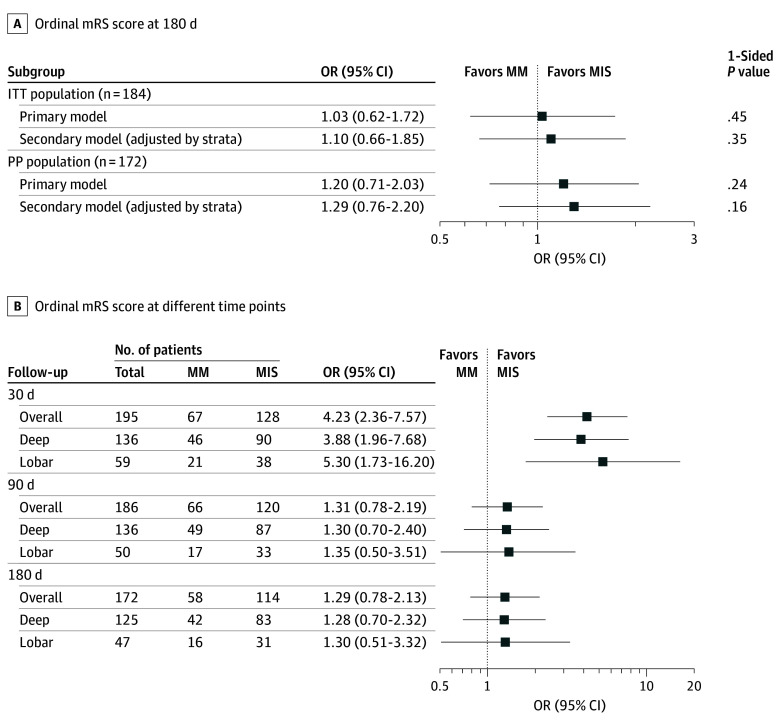
Primary Outcome (ordinal mRS at 180 days, ITT):
- Unadjusted ITT: OR 1.03 (96% CI, 0.62–1.72; P = .45) — no significant benefit of MIS
- Strata-adjusted ITT: OR 1.10 (96% CI, 0.66–1.85; P = .35)
- Per-protocol unadjusted: OR 1.20 (96% CI, 0.71–2.03); adjusted OR 1.29 (96% CI, 0.76–2.20; P = .16)
Primary Safety Outcome (30-day mortality, AT):
- MIS 11/152 (7.2%) vs MM 8/82 (9.8%); difference −2.5% (95% CI, −11.7% to 4.8%). No significant difference; log-rank P = .51.
Secondary Outcomes:
- Utility-weighted mRS at 180 d: 0.41 (MIS) vs 0.38 (MM); difference 0.04 (95% CI, −0.04 to 0.12)
- mRS ≤3 at 180 d: 53/144 (36.8%) vs 29/78 (37.2%); OR 1.03 (0.58–1.84)
- mRS ≤2 at 180 d: 24/144 (16.7%) vs 13/78 (16.7%); OR 1.05 (0.49–2.22)
- Length of hospital stay: 15 vs 16 d (difference −2; 95% CI, −5 to 1); ICU: 5.5 vs 6 d (difference −0.5; −2 to 1) — directional, not significant
- 180-day mortality: 20/152 (13.2%) vs 15/82 (18.3%); difference −5.1% (95% CI, −16.1% to 4.5%)
Exploratory (ordinal mRS at 30 days, PP adjusted):
- Overall OR 4.23 (95% CI, 2.36–7.57); lobar OR 5.30 (1.73–16.20); deep OR 3.88 (1.96–7.68). Benefit attenuated by 90 and 180 days. Post-hoc/exploratory — not powered.
Adverse Events / Safety:
- SAEs within 180 d: 80/152 (52.6%) MIS vs 56/82 (68.3%) MM; difference −15.7% (95% CI, −28.1% to −1.1%) — significant
- Any AE within 180 d: 126/152 (82.9%) vs 73/82 (89.0%; difference −6.1%; −14.9% to 4.1%)
- Procedure: EVD placement 12.5% (18/144); conversion to craniotomy 1.4% (2/144); significant procedural hemorrhage requiring cauterization 6.3% (9/144)
Figures

Source: PMC PMC12406146 — jamaneurol-e253151-g001.jpg. Click image to expand.
Source: PMC PMC12406146 — jamaneurol-e253151-g002.jpg. Click image to expand.
Criticisms
- Early stopping / underpowering: Enrollment stopped at 236 of a larger planned target on October 11, 2023 — first for loss of equipoise in lobar ICH after ENRICH, then by a feasibility analysis. The trial was not powered to detect smaller true differences; a null is not proof of equivalence.
- Exploratory vs prespecified: The striking 30-day mRS benefit (OR 4.23) and the SAE reduction are exploratory/post-hoc analyses not adjusted for multiple comparisons; they should not be read as definitive.
- No survival difference despite marked volume reduction: Only ~80% of treated patients achieved residual ICH <15 mL, yet no 180-day functional or mortality benefit — either volume reduction itself doesn’t drive late outcome, or the cohorts differed in ways not fully accounted for.
- Blinding: 180-day mRS assessors were blinded, but 30- and 90-day evaluations were not — the early-benefit signal is the least blinded.
- Timing: Median MIS was 27.5 h (38.7% ≤24 h) — later than ENRICH (16.8 h), possibly blunting any early intervention effect.
- External validity: Smaller hemorrhages and lower MM-arm mortality (9.8% vs 18.0% in ENRICH) than the positive contemporaneous trial; Black participants underrepresented relative to ICH incidence.
- Sponsor involvement: Penumbra (device manufacturer) contributed to design, data collection, and analysis.
Funding
Supported by Penumbra, Inc. Penumbra contributed to the design and conduct of the study; collection, management, analysis, and interpretation of the data; preparation, review, or approval of the manuscript; and decision to submit for publication. Registered at ClinicalTrials.gov: NCT03342664.
The paper
- Authors. Arthur AS et al. (14 authors), for the MIND Study Investigators and Collaborators.
- Title. Minimally Invasive Surgery vs Medical Management Alone for Intracerebral Hemorrhage: The MIND Randomized Clinical Trial.
- Journal. JAMA Neurology.
- Year. 2025.
- DOI. 10.1001/jamaneurol.2025.3151
- PMCID. PMC12406146
Deep Dive — click to expand
What this is
MIND asked whether endoscopic, minimally invasive evacuation of a spontaneous supratentorial hemorrhage (20–80 mL) within 72 hours improves functional outcome over best medical management alone. It is important because it is the second large modern RCT (after ENRICH, which was positive) on this question, using a different device (Artemis vs BrainPath) and a different population (70% deep bleeds vs ENRICH’s 70% lobar). The headline result is a null: ordinal mRS at 180 days was essentially identical (OR 1.03, 96% CI 0.62–1.72), 30-day mortality was not reduced, yet the surgery was technically spectacular — ~80% volume reduction, >98% procedural success, fewer serious adverse events.
1. Shadow Audit
The paper’s framing leans on the “meaning” caveat — MIS achieved efficient, safe, substantial hemorrhage reduction — but let’s state plainly what the null conceals: MIS reduced 180-day serious adverse events by 15.7% (52.6% vs 68.3%, 95% CI −28.1% to −1.1%) and produced an ordinal mRS benefit at 30 days of OR 4.23 (2.36–7.57), a huge early signal that collapsed by 90 days. The deep/lobar split matters: the Kaplan–Meier curves separated for lobar but not deep bleeds (eFigure 3), aligning with ENRICH — yet this lobar subgroup, the one where surgery most plausibly works, is the subgroup that stopped enrolling early. So the trial that “failed” is also the trial that couldn’t finish testing the subgroup where the intervention is most likely to work.
2. Inversion Engine
For MIS to actually be harmful (the opposite of the exploratory benefit), the 30-day ordinal benefit (OR 4.23) and SAE reduction (15.7 points) would have to be chance artifacts, and the numerically higher trend in 180-day mortality in MM (18.3% vs 13.2%) would have to invert. To flip the primary conclusion to a positive trial, you would need the 180-day ordinal OR to move from 1.03 to roughly the low bound of a meaningful effect — a common-odds OR of ~1.5–1.7 (≈ a one-step mRS improvement in one in three patients). Given the 96% CI already spans 0.62–1.72, the sample (236) would have needed to be on the order of 2–3× larger to reach that, which is precisely why the early-stop decision is so consequential.
3. Second-Order Catalyst
If the exploratory signal is real, the first movers are high-volume endovascular/neurointerventional comprehensive stroke centers that already staff 24/7 EVT call. A center with an existing neurosurgical AND (interventional) footprint can operationalize a “burr-hole evacuation within 24–72 h for lobar ICH 20–80 mL” pathway within weeks — the target patient is a lobar-ICH patient already on the scanner. The protocol that moves first is the lobar-ICH hemorrhage pathway and the EM/neuro triage rule that gets a lobar hemorrhage (not just a deep one) routed to a center that can evacuate. Institutionally, this is a door-to-suite metric, not a new drug or device approval.
4. Asymmetric Leverage
The leverage is asymmetric in two directions. Large denominator: ICH is 10–15% of strokes, and MIND’s own data show MM-arm 30-day mortality ~10% (and ~18% in ENRICH) — an intervention that shaves even 2.5 points of early mortality across the whole ICH population, at the price of a safe invasive procedure, has enormous absolute reach. Small denominator but concentrated payoff: the lobar ICH subgroup is roughly a third of MIND patients but carries the distinguishing benefit signal and is the one ENRICH proved — a relatively rare stroke type where a single-procedure benefit concentrates. The asymmetric play is that a small, cheaply-demonstrated benefit in lobar ICH could be worth as much as a large fragile signal spread across all ICH.
5. Paradigm Destroyer
MIND kills the reflexive “no surgery for supratentorial ICH — STICH settled it” habit that still governs many stroke and neurosurgical protocols. It does not resurrect craniotomy, but it reframes the question from whether evacuation helps to which device, which location, and how early. Two sentences any call schedule could update tomorrow: (1) A lobar supratentorial ICH of 20–80 mL in a patient under 81 with NIHSS ≥6 and good premorbid status should trigger an immediate neurosurgical/endovascular MIS consult, not a week of watchful waiting; (2) the earlier the evacuation (target <24 h, versus MIND’s median 27.5 h), the more the 30-day signal is worth capturing. The “treat blood pressure and hope” default for operable lobar bleeds is the reflex under threat.
MVP — Minimum Viable Proof
The minimum claim that, if true, would change bedside practice: Lobar supratentorial ICH (20–80 mL) evacuated within ~16–24 hours with a clean endoscopic technique reduces early disability (30-day ordinal mRS shift from mRS 5 toward 4–3) and lowers 180-day serious adverse events by ~15 absolute percentage points, without increasing mortality. If that statement holds — as both MIND’s exploratory analysis and ENRICH’s positive lobar result suggest — bedside practice for lobar ICH evacuation changes now.
Best Combination
The cleanest read combines MIND with ENRICH rather than pitting them: ENRICH gave the positive lobar signal with earlier surgery (16.8 h vs MIND’s 27.5 h) and larger hematomas (~55 vs ~41 mL); MIND gives the mechanistic proof that the quality of evacuation (80% volume reduction) and safety are achievable in practice — an ~80–90% vs ~72% (ENRICH) / 59% (MISTIE III) rate of hitting the <15 mL evacuation target. Together they triangulate: early, technically complete minimally invasive evacuation of lobar ICH is a credible, safe intervention, and its benefit is time- and location-dependent. The gap MIND exposes is the 27.5-h median timing and the deep-bleed question — the open frontier, not a settled no.
Overvalue Warning
Two things readers might overinterpret. First, the enormous exploratory 30-day odds ratio (OR 4.23) — this is post-hoc, unblinded, not adjusted for multiplicity, and it attenuated to null by day 90; it is a hypothesis-generating signal, not a license to claim MIND “works.” Second, don’t invert the null into a “surgery is useless” verdict: MIND was underpowered by early stopping, tested later-than-ideal timing, and its own data show a lobar survival-ever-trend and a significant SAE benefit; concluding “no benefit, never operate” overreads an underpowered null every bit as much as concluding “MIND proved benefit” overreads an exploratory signal. Balance both.
Educational use notice. The Clotbust Review is dedicated to medical education. Figures from published articles are embedded for teaching purposes, with attribution to the original publication. We do not claim copyright over any embedded figure; all rights remain with the original publisher and authors under the article's published license. If you are a rights holder and would like a figure removed, please contact the editorial team. See our editorial notice for the full policy.