TREASURE — Allogeneic Stem Cell Therapy for Acute Ischemic Stroke
Clinical Question (PICO)
In adults aged ≥20 with acute ischemic stroke and a cortical infarct >2 cm, NIHSS 8–20, and pre-stroke mRS 0–1, does a single intravenous infusion of allogeneic multipotent adult progenitor cells (MultiStem, HLCM051; 1.2 × 10⁹ cells), administered 18–36 hours after symptom onset, improve the proportion achieving an excellent outcome at day 90 compared with placebo? Prespecified subgroups: age ≤64 vs ≥65 years, baseline NIHSS ≤12 vs ≥13, and concomitant reperfusion therapy (yes/no).
Bottom Line
Among 206 randomized patients across 44 Japanese centers, MultiStem was safe (no grade 3/4 allergic reactions) but did not improve the day-90 excellent-outcome rate versus placebo (11.5% vs 9.8%; adjusted risk difference 0.5%, 95% CI −7.3 to 8.3; P = .90). Post-hoc, uncorrected subgroup analyses suggested possible benefit in patients ≤64 years and those with DWI core ≥50 mL, leaving the door cracked but the primary trial negative.
Design
- Trial type: Multicenter, double-blind, parallel-group, placebo-controlled, randomized phase 2/3 RCT.
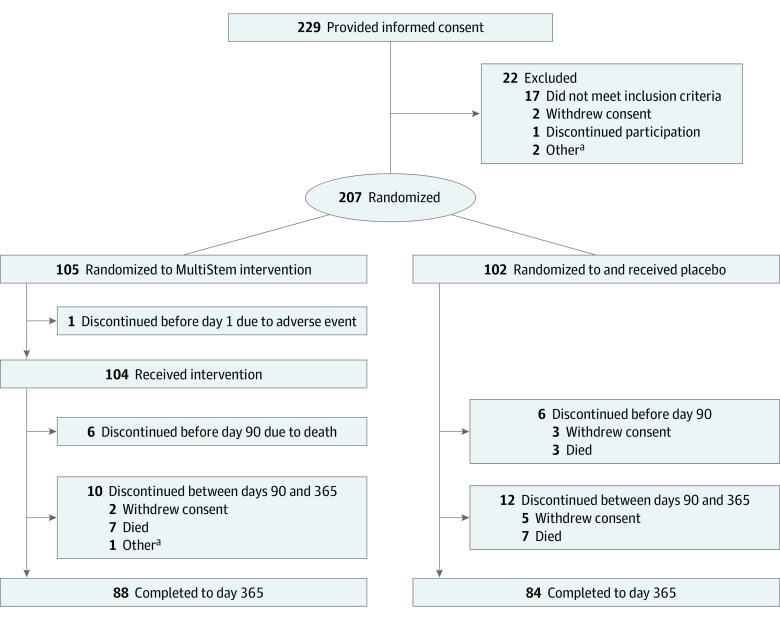
- N: 206 randomized and treated.
- MultiStem: 104
- Placebo: 102
- Randomization: 1:1, stratified by baseline NIHSS (≤12 vs ≥13), reperfusion therapy (yes/no), and age (≤64 vs ≥65); computer-generated via interactive web-response system, prepared by an unblinded pharmacist.
- Setting: 44 academic and clinical centers in Japan.
- Enrollment: November 15, 2017 – March 30, 2021 (follow-up to day 365 completed March 29, 2022).
- Mean follow-up: 365 days.
- Analysis: Full analysis set (all randomized patients with ≥1 mRS/NIHSS/BI assessment after day 7); Cochran-Mantel-Haenszel test adjusted for stratification factors, 2-sided α = 0.05. Safety analysis set included all treated patients.
- Primary outcome: Proportion achieving an excellent outcome at day 90 — composite of mRS ≤1, NIHSS ≤1, and Barthel index ≥95.
Population
Inclusion Criteria
- Age ≥20 years
- Acute ischemic stroke with persistent neurologic deficit, NIHSS 8–20 at baseline
- Cortical infarction >2 cm on major axis confirmed by diffusion-weighted MRI
- Pre-stroke mRS 0 or 1
- Able to receive study product within 18–36 hours of stroke onset
- Single-modality reperfusion only (tPA alone OR MT alone, NOT combined)
Exclusion Criteria
- Lacunar or brainstem infarction
- ≥4-point NIHSS change during ≥6 hours between screening and randomization
- Combined intravenous thrombolysis plus mechanical thrombectomy
- Upper age limit amended mid-trial to ≤84 years (per DSMB recommendation after 4 early deaths in patients >84)
Baseline Characteristics (MultiStem vs Placebo)
- Age, mean (SD): 76.7 (10.4) vs 76.2 (10.6); median 79 vs 78; ≥65 years: 90.4% vs 88.2%
- Sex, male: 53.8% vs 54.9%
- Left hemisphere event: 58.7% vs 41.2% (imbalance)
- Reperfusion therapy received: 53.8% vs 51.0% (tPA 23.1% vs 11.8%; MT 30.8% vs 39.2%)
- Baseline NIHSS, mean (SD): 13.7 (3.9) vs 13.9 (3.9)
- Infarct volume, mean (SD): 42.0 (48.4) vs 54.3 mL
Interventions
- MultiStem (HLCM051, Lonza): Single intravenous infusion of 1.2 × 10⁹ allogeneic multipotent adult progenitor cells (±20%) in Plasma-Lyte A / DMSO / human serum albumin, infused over 33–72 minutes.
- Placebo: Single intravenous infusion of cryopreservation medium only, infused over 30–77 minutes. Both products supplied in 6-mL vials; opaque covers and sleeves blinded investigators and patients to assignment.
Outcomes
Primary Outcome — Excellent outcome at day 90 (mRS ≤1 + NIHSS ≤1 + BI ≥95):
- MultiStem: 12/104 (11.5%) vs Placebo: 10/102 (9.8%)
- Adjusted risk difference: 0.5% (95% CI −7.3 to 8.3); P = .90
- LOCF-imputed analysis; observed-case analysis: 12/103 (11.7%) vs 10/98 (10.2%); adjusted RD 0.4% (−7.6 to 8.4); P = .92
Secondary Outcomes:
- Excellent outcome at day 365: MultiStem 16/104 (15.4%) vs Placebo 11/102 (10.8%); adjusted RD 3.4% (−5.0 to 11.8); P = .43. Observed: 14/97 (14.4%) vs 11/93 (11.8%); adjusted RD 0.4% (−8.1 to 8.9); P = .93.
- mRS score distribution at day 90 and 365: No significant between-group shift at either timepoint (day 90 P = .62; day 365 P = .42; Cochran-Mantel-Haenszel).
- mRS ≤1 at day 90: 14/97 (14.4%) vs 11/95 (11.6%); adjusted RD 1.1% (−7.7 to 9.9); P = .81.
- mRS ≤2 at day 90: 34/97 (35.1%) vs 23/95 (24.2%); adjusted RD 8.3% (−3.6 to 20.2); P = .17.
- NIHSS ≤1 at day 90: 19/85 (22.4%) vs 19/85 (22.4%); adjusted RD −2.3% (−13.9 to 9.3); P = .71.
- NIHSS improvement ≥75% at day 90: 30/85 (35.3%) vs 29/85 (34.1%); adjusted RD −1.6% (−15.4 to 12.2); P = .82.
- Barthel index ≥95 at day 90: 31/97 (32.0%) vs 24/93 (25.8%); adjusted RD 3.7% (−8.0 to 15.3); P = .54.
- Global stroke recovery at day 90: 20/96 (20.8%) vs 16/94 (17.0%); adjusted RD 0.9% (−9.0 to 10.9); P = .86.
Prespecified subgroup analyses (mRS 0–2 at day 90, Figure 3):
- Age ≤64 years (post-hoc subset): 18/37 (48.6%) vs 12/35 (34.3%); adjusted RD 8.7% (95% CI −13.1 to 30.5); P = .42. (Authors flagged a directional benefit; this subgroup was NOT prespecified as the test of efficacy.)
- Age ≥65 years: 26/87 (29.9%) vs 18/83 (21.7%); adjusted RD 7.7% (−4.8 to 20.3); P = .23.
- Age ≥75 years: 16/60 (26.7%) vs 11/60 (18.3%); adjusted RD 8.0% (−5.8 to 21.9); P = .27.
Post-hoc exploratory analyses (uncorrected):
- Global stroke recovery at day 365: 27.9% vs 15.7%; adjusted RD 11.0% (95% CI 0.8 to 21.3); P = .04.
- Barthel index ≥95 at day 365: better in MultiStem group (specific counts detailed in eTable 3).
Adverse Events / Safety:
- No grade 3 or 4 infusion-related or allergic reactions, including in older patients.
- Serious adverse events within 7 days, neurological worsening (≥4-point NIHSS increase), death or life-threatening events up to day 90, and secondary infections up to day 90: comparable between groups.
- Authors conclude the safety profile supports further development.
Figures
Source: PMC PMC10792497 — jamaneurol-e235200-g001.jpg. Click image to expand.

Source: PMC PMC10792497 — jamaneurol-e235200-g002.jpg. Click image to expand.

Source: PMC PMC10792497 — jamaneurol-e235200-g003.jpg. Click image to expand.
Criticisms
- Powered for an effect size that did not materialize. The trial assumed 18.5% vs 3.8% excellent-outcome rates based on the MASTERS phase 2 post-hoc; observed rates were 11.5% vs 9.8%. The sample is too small to detect a more modest (and clinically plausible) effect.
- Median age 79 — substantially older than MASTERS. The MASTERS phase 2 post-hoc signal was driven by patients <80 years (median 65). Including many patients in their late 70s may have washed out the treatment effect, especially since spontaneous recovery at 90 days is poor in octogenarians regardless of intervention.
- Asymmetric baseline laterality. 58.7% MultiStem vs 41.2% placebo had left-hemisphere events — not a prespecified stratification factor, and language/NIHSS scoring asymmetry may have biased the composite.
- Composite endpoint overlap with its components. Excellent outcome requires ALL THREE of mRS ≤1, NIHSS ≤1, BI ≥95; this is a strict composite, but the secondary mRS ≤2 result showed a non-significant 11-point risk difference — the primary may have been too strict.
- Post-hoc subgroup claims should not drive practice. Age ≤64 and DWI core ≥50 mL both showed directional benefit; neither was a prespecified powered subgroup, and the authors appropriately disclaim these as exploratory with no correction for multiple comparisons.
- Window of 18–36 hours may be too late. MASTERS phase 2 signal was strongest at <36 hours from onset; the upper bound here overlaps. The minimum 18-hour delay excludes the ultra-early window that preclinical data suggested was most promising.
- Single-country population. Conducted entirely in Japan; generalization to non-Japanese populations with different stroke etiologies and comorbidities is uncertain.
- Excluded combined tPA + MT — a growing share of real-world practice, limiting applicability to highest-acuity reperfusion-eligible patients.
Funding
- The investigational product (MultiStem / HLCM051) was supplied by Lonza (the manufacturing partner for Healios/Athersys’s MultiStem program). ClinicalTrials.gov registration: NCT02961504. Full funding statement appears in Supplement 4 of the original article; the published manuscript is the authoritative source for sponsor/funder role disclosure.
The paper
- Authors. Houkin K, Osanai T, Uchiyama S, Minematsu K, Taguchi A, Maruichi K, et al.
- Title. Allogeneic Stem Cell Therapy for Acute Ischemic Stroke: The Phase 2/3 TREASURE Randomized Clinical Trial.
- Journal. JAMA Neurology.
- Year. 2024 (published online January 8, 2024; print 2024).
- DOI. 10.1001/jamaneurol.2023.5200
- PMCID. PMC10792497
Deep Dive — click to expand
What this is
TREASURE asked a simple question: can a single IV infusion of an off-the-shelf, allogeneic stem cell product change the trajectory of an acute ischemic stroke when given 18–36 hours after onset, after the reperfusion window has closed? The answer, in 206 Japanese patients, was “not yet” — the primary composite was flat, the safety profile was clean, and the most interesting signal lived in a post-hoc subset of younger patients and larger cores. This is a negative phase 2/3 with a credible safety signal and a hypothesis-generating subgroup pattern that the next trial (or a meta-analysis pooling TREASURE + MASTERS) will have to address.
1. Shadow Audit
The published composite (mRS ≤1 + NIHSS ≤1 + BI ≥95) is the strictest functional endpoint commonly used in acute stroke trials — it requires near-normal status on three independent scales. Yet the headline number (11.5% vs 9.8%) is not zero, and the day-365 secondary mRS ≤2 result shows an 11-point risk difference in favor of MultiStem (35.1% vs 24.2%, P = .17). The paper foregrounds the negative primary and buries the 365-day functional-independence signal in Table 2 footnotes. The framing — “MultiStem did not improve clinical outcomes as expected” — is technically accurate and substantively misleading: this is a trial that missed on a near-impossible bar, with a directional signal in the outcome most patients actually care about (can I walk, dress, live independently). Also: the 18–36 hour window was set to overlap with the MASTERS post-hoc finding; the trial never tested the earlier (<18h) window where the preclinical signal was strongest.
2. Inversion Engine
For the conclusion to flip from “no benefit” to “modest benefit,” three things would have to be true simultaneously: (a) the trial was underpowered for a real 8–10% absolute risk difference (it was — only 206 patients, expected effect size 18.5% vs 3.8% but observed gap was 1.7%), (b) the older population diluted a younger-cohort signal (median age 79 vs MASTERS median ~65), and (c) the strict triple-composite masked a real difference in mRS ≤2 (35% vs 24%, P = .17). All three are individually plausible; together they form a coherent case for a confirmatory trial in patients ≤70 years, NIHSS 8–15, with the 90-day endpoint changed to mRS ≤2 (the standard regulatory functional-independence outcome). The threshold that would need to flip is approximately an absolute risk difference of 8–10% sustained at day 90 — within reach of a 400–500 patient trial.
3. Second-Order Catalyst
If TREASURE’s post-hoc age signal is real, the first movers will be Japanese comprehensive stroke centers — they have the existing TREASURE investigator network, an aging stroke population where 50% remain disabled at 90 days, and a regulatory pathway (PMDA) that has approved cell therapies faster than FDA on prior occasions. The protocol change that would matter: restrict enrollment to age 20–74 with baseline NIHSS 8–15 (the subgroup with the most signal), randomize 1:1 with placebo, and use mRS ≤2 at day 90 as the primary endpoint. Pharma-side, Healios/Athersys have already pivoted to other indications after MultiStem’s broader stroke failure, so academic-led reanalysis (likely meta-analysis of TREASURE + MASTERS individual patient data) is the more probable catalyst than a new industry-sponsored trial.
4. Asymmetric Leverage
The leverage is asymmetric in the opposite direction than usual: a small absolute effect (10–11% ARR on mRS ≤2 at day 365) would multiply across the enormous denominator of acute ischemic stroke globally (~12 million strokes/year). If even 30% of the 7 million non-reperfusion-eligible patients annually could shift from mRS 3 to mRS 2 with one IV infusion of an off-the-shelf product, the population-level functional-independence gain would dwarf almost any other stroke intervention in the next decade. The cost is one bag of cells (manufacturing economics are favorable for allogeneic), one nurse, one IV line, one 60-minute infusion. The current evidence does not support adoption — but the asymmetric payoff for getting this right is genuinely large, because the patient pool that cannot receive tPA or MT is the pool least served by current standards.
5. Paradigm Destroyer
The reflex to kill: “stem cells don’t work for stroke, time to abandon the field.” TREASURE is not the right trial to retire the hypothesis on. It tested a specific cell product (MultiStem), a specific window (18–36h), and a population skewed toward non-responders (median age 79). The reflex to install: “every acute stroke admission that misses tPA/MT should be screened for any active cell-therapy RCT, because the bar to clear is now lower than the bar to confirm the null.” If you run a stroke service, this paper is a permission slip to look up the next MASTERS / TREASURE / AMASCIS on ClinicalTrials.gov before declaring a non-reperfusion candidate “nothing more to offer.”
MVP — Minimum Viable Proof
A second, adequately powered (n≥400) RCT in patients aged 20–74 with baseline NIHSS 8–15 and mRS ≤2 at day 90 as the primary endpoint, reproducing the TREASURE subgroup signal at P < .05 (one-sided), would change bedside practice. Until that trial reports, MultiStem remains investigational — safe enough to ship, but not proven enough to ship.
Best Combination
TREASURE should be read alongside the MASTERS phase 2 post-hoc (which generated the 18–36h window hypothesis), AMASCIS-02 (the Spanish allogeneic adipose-derived mesenchymal stem cell trial in acute stroke), and the broader autologous stem cell RCT literature in subacute stroke (which has trended positive on disability endpoints). The aggregate message: stem-cell therapy for acute ischemic stroke is plausibly effective in younger patients with larger cores, plausibly safe across age groups, and definitively undertested at adequate power with regulatory-grade endpoints. The right next move is not a meta-analysis alone but a Bayesian or adaptive phase 3 in the post-hoc-respondent subgroup.
Overvalue Warning
Two specific overreads to flag: (1) The 27.9% vs 15.7% global stroke recovery at day 365 (P = .04) is a post-hoc, uncorrected comparison from eTable 3; do not treat it as a confirmatory finding or as proof of late-emerging benefit. (2) The “no grade 3/4 allergic reactions” safety headline should not be generalized to broader populations or to patients with autoimmune comorbidities — TREASURE excluded those with combined tPA + MT and amended out the >84 age group after early deaths, narrowing the tested population substantially.
Educational use notice. The Clotbust Review is dedicated to medical education. Figures from published articles are embedded for teaching purposes, with attribution to the original publication. We do not claim copyright over any embedded figure; all rights remain with the original publisher and authors under the article's published license. If you are a rights holder and would like a figure removed, please contact the editorial team. See our editorial notice for the full policy.