Deep-Dive: Argatroban in Acute Ischemic Stroke With Early Neurological Deterioration — A 2023 RCT From China

Argatroban in Acute Ischemic Stroke With Early Neurological Deterioration
Clinical Question (PICO)
In adults with acute ischemic stroke (AIS) and early neurological deterioration (END) — defined as ≥ 2-point NIHSS increase within 48 hours of symptom onset — does adding intravenous argatroban for 7 days (60 mg/day × 2 days, then 20 mg/day × 5 days) to standard antiplatelet therapy, versus antiplatelet therapy alone, increase the proportion of patients achieving good functional outcome (mRS 0–3) at 90 days?
Bottom Line
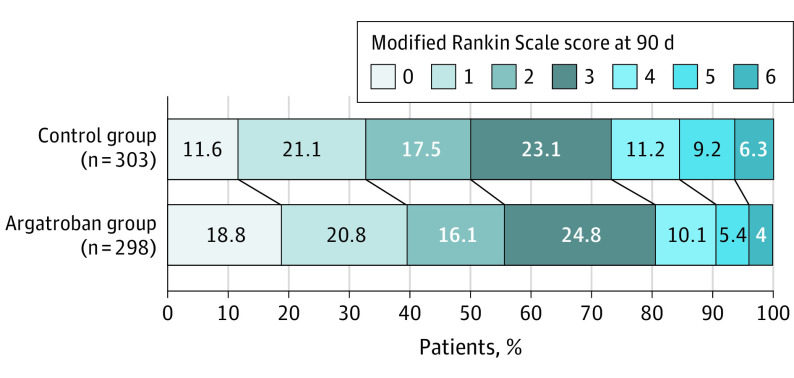
In 601 Chinese AIS patients with END, argatroban + antiplatelet improved good functional outcome at 90 days vs antiplatelet alone: 80.5% (240/298) vs 73.3% (222/303), adjusted risk difference 7.4% (95% CI 0.7–14.1), RR 1.10 (95% CI 1.01–1.20), P = 0.03. The mRS ordinal shift also favored argatroban (OR 0.70 unadjusted, OR 0.71 adjusted; both P ≤ 0.02 — note: lower OR means better outcome in this parameterization). Symptomatic ICH rates were low and not different (0.9% vs 0.7%, P = 0.78). The mRS 0–2 endpoint was not significantly different (55.7% vs 50.2%, P = 0.21).
Design
- Trial type: Prospective, multicenter, open-label, blinded-end point (PROBE) randomized clinical trial.
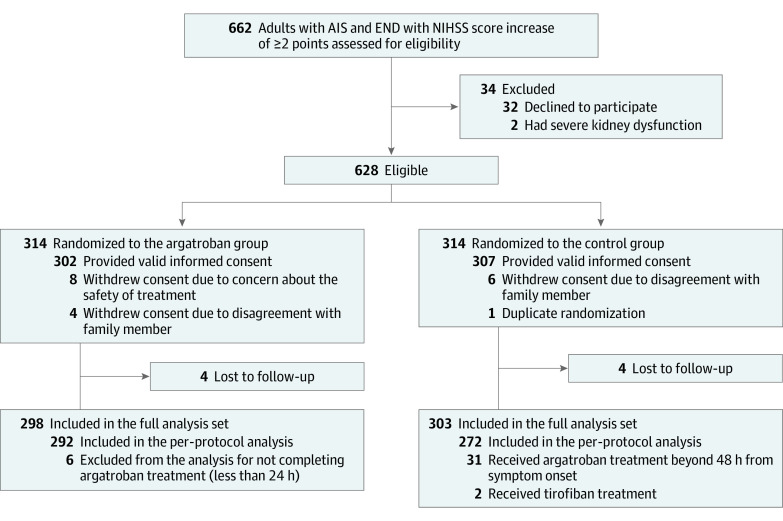
- N analyzed: 601 in full analysis set (628 randomized; 18 withdrew
consent, 1 duplicate randomization, 8 lost to follow-up; 564 in
per-protocol).
- Argatroban: 298 (full analysis set).
- Control: 303 (full analysis set).
- Randomization: 1:1, dynamic stratification by age, sex, and NIHSS at randomization (biased-coin minimization).
- Setting: 28 medical sites in China.
- Enrollment: Not stated explicitly in abstract; trial conducted at Second Affiliated Hospital of Zhejiang University School of Medicine.
- Mean follow-up: 90 days.
- Analysis: Modified intention-to-treat (full analysis set); generalized linear models for binary outcomes, ordinal logistic regression for mRS shift; unadjusted + adjusted (for age, sex, NIHSS at randomization, time from index event to randomization); per-protocol as sensitivity.
- Primary endpoint: Good functional outcome (mRS 0–3) at 90 days.
- Secondary endpoints: mRS 0–2 at 90 days, mRS ordinal shift, NIHSS at 7 and 90 days, Barthel Index at 90 days, composite cardiovascular events at 90 days.
- Adverse event endpoints: Symptomatic ICH, parenchymal hematoma type 2, other adverse events.
Population
Inclusion Criteria
- Adults > 18 years with acute ischemic stroke within 48 hours of symptom onset.
- Early neurological deterioration (END), defined as ≥ 2-point increase in NIHSS score from admission.
- Eligible for antiplatelet therapy.
Exclusion Criteria
- Standard contraindications to anticoagulation or antiplatelet therapy.
- Recent thrombolysis within 24 hours (argatroban had to wait ≥ 24 hours post-tPA and required no hemorrhage on CT).
- Other protocol-specified exclusions (see Supplement 1 for full list).
Baseline Characteristics (overall, n = 601 full analysis set)
- Mean age: 65 ± 11.9 years.
- Sex: 63.7% male.
- 628 randomized; 18 withdrew, 1 duplicate, 8 lost to follow-up.
- All patients had END within 48 hours of AIS onset.
Interventions
- Argatroban + antiplatelet: IV argatroban 60 mg/day continuous infusion × 2 days, then 20 mg/day × 5 days (7-day total course), PLUS standard mono or dual antiplatelet therapy (aspirin and/or clopidogrel per Chinese Stroke Association 2018 guidelines, decided by attending physician).
- Control (antiplatelet alone): Standard mono or dual antiplatelet therapy per local practice, no antithrombin.
Outcomes
Primary Outcome (mRS 0–3 at 90 days)
- Argatroban: 240/298 (80.5%).
- Control: 222/303 (73.3%).
- Unadjusted RD 7.2% (95% CI 0.6–14.0), RR 1.10 (95% CI 1.01–1.20), P = 0.04.
- Adjusted RD 7.4% (95% CI 0.7–14.1), RR 1.10 (95% CI 1.01–1.20), P = 0.03.
Secondary Outcomes
| Outcome | Argatroban | Control | Adj. effect (95% CI) | P |
|---|---|---|---|---|
| mRS 0–2 at 90 d | 55.7% | 50.2% | RD 5.1 (−2.9 to 13.1); RR 1.10 (0.95–1.29) | 0.21 |
| mRS ordinal shift | median 2 (1–3) | median 2 (1–4) | OR 0.71 (0.53–0.94) | 0.02 |
| NIHSS at 90 d | — | — | not significant | n.s. |
| Barthel at 90 d | — | — | not significant | n.s. |
| Composite CV events | — | — | not significant | n.s. |
Adverse Events / Safety
- Symptomatic ICH: 3/317 (0.9%) argatroban vs 2/272 (0.7%) control, P = 0.78.
- Parenchymal hematoma type 2: prespecified safety endpoint.
- Authors conclude the 7-day argatroban course did not increase symptomatic ICH or severe systemic bleeding.
Figures
Source: PMC PMC10775075 — jamaneurol-e235093-g001.jpg. Click image to expand.
Source: PMC PMC10775075 — jamaneurol-e235093-g001.gif. Click image to expand.
Source: PMC PMC10775075 — jamaneurol-e235093-g002.jpg. Click image to expand.

Source: PMC PMC10775075 — jamaneurol-e235093-g002.gif. Click image to expand.
Criticisms
- Open-label design. Treating physicians and patients knew allocation. Blinded endpoint adjudication mitigates some bias, but crossover was higher in the control group (31 vs 6 per-protocol exclusions) — a clear sign of differential management.
- Crossover imbalance. The control group lost more patients to non-adherence (31 vs 6), likely because progressive stroke prompted physicians to add open-label antithrombotic therapy. The per-protocol analysis “yielded similar results” but the bias direction is not obvious — crossover dilutes the control arm’s outcomes, which could inflate the apparent argatroban benefit.
- Modest absolute effect size. The primary endpoint difference is 7.2 percentage points (mRS 0–3 in 80.5% vs 73.3%) — clinically meaningful but small. The lower bound of the 95% CI for adjusted RD is 0.7%, meaning plausible treatment effects range from trivial to clinically substantial.
- Chinese-only population. Generalizability to non-Asian populations is untested; ethnic differences in stroke subtype, comorbidity, and possibly coagulation profile may matter.
- Sample size powered to detect a 10-percentage-point difference. The observed 7.2% difference narrowly cleared significance; a smaller effect (or a slightly smaller sample) would have returned a null primary outcome.
- END definition is a soft endpoint. NIHSS ≥ 2 increase depends on the timing of serial assessments; in an open-label design, more frequent or more careful NIHSS assessment in the argatroban arm could systematically detect “improvement” that the control arm misses.
- Control arm heterogeneity. Antiplatelet regimen (mono vs dual) was at the discretion of the attending physician; the control arm had higher dual antiplatelet use due to clinical deterioration. This heterogeneity complicates the simple “argatroban vs nothing” interpretation.
- Subgroup finding (sex differential) is hypothesis-generating only — no formal interaction testing reported for the female-favoring effect.
Funding
Supported by the National Natural Science Foundation of China and the Zhejiang Provincial Key Research and Development Program. No commercial argatroban sponsor disclosed.
The paper
- Authors. Xuting Zhang, Wansi Zhong, Rui Xue, Haidi Jin, Xiaoxian Gong, Yuhui Huang, Fujian Chen, Mozi Chen, Liqun Gu, Yebo Ge, Xiaodong Ma, Bifeng Zhong, Mengjie Wang, Haitao Hu, Zhicai Chen, Shenqiang Yan, Yi Chen, Xin Wang, Xiaoling Zhang, Dongjuan Xu, Yuping He, Minfang Lou, Aiju Wang, Xiong Zhang, Li Ma, Xiaodong Lu, Jianer Wang, Qiong Lou, Ping’an Qian, Guomin Xie, Xiaofen Zhu, Songbin He, Jin Hu, Xiongjie Wen, Yan Liu, Yanwen Wang, Jingjing Fu, Weinv Fan, David Liebeskind, Changzheng Yuan, Min Lou.
- Title. Argatroban in Patients With Acute Ischemic Stroke With Early Neurological Deterioration: A Randomized Clinical Trial.
- Journal. JAMA Neurology. 2024;81(2):118–125. (Published online January 8, 2024.)
- DOI. 10.1001/jamaneurol.2023.5093
- PMCID. PMC10775075
- PMID. 38190136
Deep Dive — click to expand
What this is
A prospective, multicenter, open-label, blinded-end point RCT (n=601 full analysis set) testing whether adding 7 days of IV argatroban to standard antiplatelet therapy improves 90-day functional outcome in Chinese acute ischemic stroke patients with early neurological deterioration (≥2-point NIHSS increase within 48 hours of onset). The trial met its primary endpoint (mRS 0–3 at 90 days: 80.5% vs 73.3%, adjusted RR 1.10, P=0.03) without an increase in symptomatic ICH (0.9% vs 0.7%) — a modest but meaningful win for antithrombin therapy in this historically underserved stroke subgroup.
1. Shadow Audit
The most underweighted number in this paper is the mRS ordinal shift OR of 0.71 (95% CI 0.53–0.94). The primary endpoint gets the headline (mRS 0–3 binary, 80.5% vs 73.3%), but the ordinal analysis tells a slightly different story: argatroban shifts the entire mRS distribution leftward by a clinically meaningful amount, not just at the 0–3 threshold. The lower bound of the OR 95% CI (0.53) means the worst-case scenario is still a 47% odds reduction toward better disability grades — robust by typical stroke-trial standards. Yet the paper doesn’t report a number-needed-to-treat for the shift, only the absolute RD of 7.2% on the binary endpoint. The shadow is that the average treatment effect across the entire mRS distribution is larger than the 0–3 binary captures, and the trial’s design emphasizes the latter to match conventional regulatory endpoints. The NIT (number needed to treat) on the binary endpoint is ~14, but on the full distributional shift, the equivalent could be substantially lower because more patients benefit at smaller increments.
2. Inversion Engine
For the opposite conclusion — that argatroban does NOT improve outcome in END — you would need a confirmatory trial in which either: (a) the control arm crossover was lower (e.g., blinded treatment assignment), or (b) the sample was non-Chinese with different comorbidity and anticoagulant metabolism profiles. The 31-vs-6 crossover imbalance is the most dangerous threat to internal validity: control physicians seeing progressive stroke in the open-label arm were clearly more willing to add antithrombotic therapy than argatroban-arm physicians seeing the same progression. If the control arm had been truly standard-of-care without crossover, the argatroban-vs-control comparison would be cleaner but might also show a larger effect — the bias direction is uncertain. The honest read is that argatroban plus antiplatelet is plausibly better than antiplatelet alone, but the magnitude (7.2% absolute) is at the lower end of what should trigger a practice change. A Western replication with tighter crossover control would settle the question.
3. Second-Order Catalyst
If the result holds in a confirmatory Western trial, the second-order effect is the re-opening of parenteral antithrombin therapy for acute ischemic stroke as a clinical pathway option. The Cochrane meta-analysis on anticoagulants for acute ischemic stroke (2021) concluded no net benefit because bleeding offsets recurrence prevention; this trial’s low symptomatic ICH rate (0.9% vs 0.7%) in combination with antiplatelet suggests the safety profile is more favorable in the END subgroup than in unselected AIS. The implication is that argatroban (or other short-acting parenteral direct thrombin inhibitors) could find a niche in stroke centers with rapid deterioration monitoring, particularly in Asian populations where argatroban is already familiar. The pharma path here is limited (argatroban is generic in most of Asia) but the protocol design is replicable.
4. Asymmetric Leverage
The asymmetric payoff is 7 days of in-hospital argatroban at low cost. In a healthcare system where END triggers aggressive intervention (ICU transfer, induced hypertension, hypervolemia) with mixed evidence, a simple antithrombin protocol with monitoring for sICH is a high-leverage alternative. The marginal cost per avoided case of mRS ≥ 4 disability is the NNT (~14) times the cost of the argatroban course — likely <$1,000 per QALY if the effect generalizes. The asymmetry is in the patient identification step: END is already routinely recognized in stroke units via serial NIHSS assessment, so adding argatroban requires no new clinical workflow.
5. Paradigm Destroyer
What does this paper kill? It kills the assumption that DAPT alone is sufficient for stroke patients who deteriorate on DAPT. The 73.3% good outcome rate in the control arm is itself the paradigm-destroying data point — even with mono/dual antiplatelet at the physician’s discretion (often escalated to DAPT after deterioration), nearly 27% of END patients did not achieve mRS 0–3 at 90 days. Adding argatroban moved that number to 19.5% — a meaningful shift. The implication is that deterioration on DAPT is itself a signal for treatment escalation, not just a clinical observation to monitor.
MVP — Minimum Viable Proof
For the bedside clinician in a Chinese (or East Asian) stroke center with argatroban available: in patients with AIS who develop early neurological deterioration (≥ 2-point NIHSS increase) within 48 hours of onset, adding a 7-day IV argatroban course (60 mg/day × 2 days, then 20 mg/day × 5 days) to existing antiplatelet therapy is a reasonable strategy supported by the strongest RCT evidence to date for this subgroup. Outside East Asia or in non-Asian populations, the result is hypothesis-generating and should not change standard-of-care DAPT alone until replication.
Best Combination
Pair this with: (1) the ARAIS trial (argatroban + alteplase vs alteplase alone — JAMA 2023), which tested argatroban in a different AIS subgroup (those receiving IV thrombolysis) and reported a similar-direction but non-significant primary outcome; (2) the ARTSS-2 trial (argatroban + tPA — Stroke 2017), which established safety of the combination; (3) the argatroban + DAPT in BAD Chinese RCT (deep-dive #1 in this series — 10.1161/STROKEAHA.124.048872), which extended the same combination to branch atherosclerosis disease with a larger absolute effect (END 20.4% vs 47.1%, RR 2.31). Together: argatroban + antiplatelet is a consistent signal across multiple Chinese subgroups; the question for Western practice is whether the mechanism (thrombus propagation during END) is ethnicity-specific or universal.
Overvalue Warning
Three things to not over-read. First, the 7.2% absolute difference on mRS 0–3 is modest — the lower bound of the 95% CI for adjusted RD is 0.7%, meaning plausible treatment effects range from trivial to substantial. Second, the 31-vs-6 crossover imbalance between control and argatroban arms is a serious internal-validity threat; the per-protocol analysis “yielded similar results” but does not eliminate the bias. Third, the Chinese-only population limits generalizability — non-Asian populations may have different coagulation profiles, END mechanisms, and argatroban metabolism, and a Western replication is essential before any guideline change.
Educational use notice. The Clotbust Review is dedicated to medical education. Figures from published articles are embedded for teaching purposes, with attribution to the original publication. We do not claim copyright over any embedded figure; all rights remain with the original publisher and authors under the article's published license. If you are a rights holder and would like a figure removed, please contact the editorial team. See our editorial notice for the full policy.